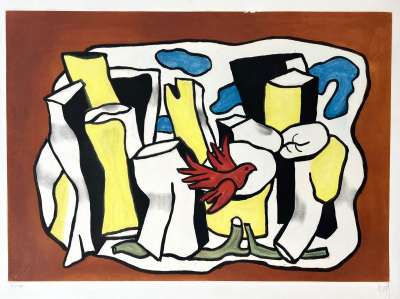
Aquatint, 1953
Edition: 81/125
Publisher/Printer: Lacourière (Paris)
Catalogue: Saphire E19
Image size: 45 × 63.5 cm
Signed in pencil
Comes with a certificate of authenticity
Condition: Very good
BFK Rives paper
Slight restoration marks on the margins
Minor loss at the top edge
Print based on a gouache work
This piece is held by our affiliated gallery in France. While its condition is rated as good by French standards, please note that standards for assessing the condition of vintage items may differ between France and Japan. Please consider purchasing only if you are comfortable with signs of age (e.g., stains, discoloration, folds, creases, tanning) inherent to a vintage item. We have not personally inspected the physical item. The artwork is currently stored in France, and delivery will take over two weeks after your order. Due to the nature of the artwork, returns after purchase are not accepted.
The forest depicted in this work rises like a city, its trunks forming architectural structures. The title, "The Red Bird," imbues this magnificent space with a narrative quality.
The 1950s was a period of innovation in printmaking, and this work was produced at the highly creative Lacourière workshop. While Léger is often spoken of as a painter of the modern world and mechanical civilization, he also held a deep affection for nature.
He once said:
"An oak tree destroyed in twenty seconds takes a century to grow back. Birds are always impeccably dressed. The word 'progress' is meaningless, since the cow that feeds the world always walks at three kilometers an hour."
This work embodies Léger's characteristic sense of volume and monumentality, drawing the viewer into a poetic world of imagination. It is a piece that invites quiet contemplation, harmonizing nature and structure, strength and lyricism.
About Fernand Léger
Fernand Léger (1881–1955) was a prominent French modern painter of the early 20th century. While influenced by Cubism, he established his unique expression and is known for his powerful forms centered on the "contrast" of form, color, and volume.
After his experiences in World War I, he developed a "mechanical style" incorporating modern motifs such as machines and cities. After the war, his work evolved to include more vibrant colors and voluminous human figures, creating clear and vital compositions.
Beyond painting, he was active in various fields, including murals, stage design, and architectural collaborations, leaving a significant mark on the development of modern art.