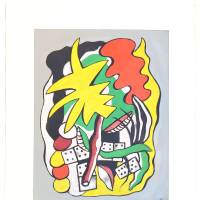
Stencil, 1947
Edition: 23/30 H.C. + 300
Publisher: Guy Spitzer (Paris)
Printer: Guy Spitzer (Paris)
Catalogue: Saphire n°E20 p.290-291
Paper size: 88 × 70 cm
Image size: 63.7 × 50 cm
Framed size: 91.4 × 72 cm
Signed in pencil
Comes with a certificate of authenticity
Condition: Very good
Spitzer dry stamp on the bottom left
Tear less than 1cm on the upper center margin
This stencil work was created based on an oil painting on canvas.
This piece is stored by our partner gallery in France. While the condition is considered good by local (French) standards, please note that the criteria for evaluating the condition of aged items may differ between France and Japan. Please consider purchasing only after acknowledging any signs of age and use (e.g., stains, discoloration, folds, creases, fading) as part of its vintage nature. We have not personally inspected the physical item. The artwork is currently stored in France, and delivery after ordering will take more than two weeks. Due to the nature of the artwork, returns after purchase are not accepted.
In a mysterious composition filled with vibrant colors, organic and botanical forms unfold like an ever-growing world of life. In contrast, the geometric and graphical shapes of dominoes are placed.
This combination of organic and geometric forms was the harmony Leger sought.
As he said, "An object is valuable not by its meaning, but by its plastic value."
About Fernand Léger
Fernand Léger (1881–1955) was a leading French modern painter of the first half of the 20th century. While influenced by Cubism, he established his own unique expression and is known for his powerful forms centered on the "contrast" of form, color, and volume.
After his experiences in World War I, he developed a "mechanical style" that incorporated modern motifs such as machines and cities. After the war, his work evolved into more vibrant colors and voluminous human figures, creating clear and vital canvases.
He was active not only in painting but also in a wide range of fields such as murals, stage design, and collaborations with architecture, leaving a significant mark on the development of modern art.