ギャルリー亜出果
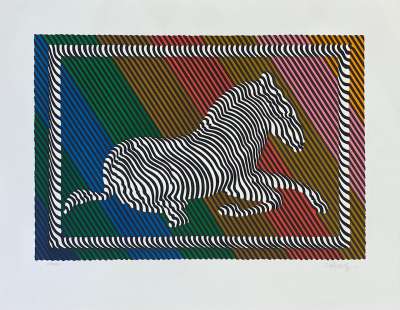
Victor Vasarely Zebra 3
Victor Vasarely Zebra 3
Couldn't load pickup availability
Lithograph, 1984
Limited Edition of 125 (108/125)
Published by Graphos Verlag A.G.
Printed by Silium (Paris)
Catalogue: Benavides 986
61.00 cm × 78.00 cm (sheet size)
44.00 cm × 64.00 cm (image size)
Hand-signed by the artist in pencil
Certificate of Authenticity included
Condition: Very good
This artwork is held by our partner gallery in France. While its condition is rated as good by local (French) standards, please note that evaluation criteria for vintage items may differ between France and Japan. Please consider this with an understanding of typical signs of age (e.g., stains, discoloration, creases, wrinkles, foxing) inherent in vintage pieces before purchasing. We have not personally inspected the physical artwork. The piece is currently stored in France, and delivery may take more than 2 weeks after your order. Due to the nature of the artwork, returns after purchase are not accepted.
Artwork Description
《Zebra 3》 is an extremely important lithograph that develops the "Zebra" series, which symbolizes Victor Vasarely’s artistic starting point.
For Vasarely, the "Zebra" was not merely an animal motif; it was the origin of his research into optical illusion and movement. Early Zebra works created from the late 1930s to the 1940s are widely recognized today as some of the earliest experiments in Op Art.
In this work, a galloping zebra emerges against a background of diverse stripes, where its striped pattern intricately intersects with the color rhythm of the background. This composition creates a strong sense of vibration and dynamism on the canvas, conveying the animal's vitality as visual energy.
The zebra's stripes were an ideal medium for Vasarely's visual experiments. The repeating black and white lines blur outlines and destabilize forms, constantly creating changing illusions in the viewer's perception.
The image of the zebra running at full speed transcends mere naturalistic depiction, appearing as an embodiment of "movement itself" visually. This can be seen as a reinterpretation of the study of "movement" since the Futurists of the early 20th century, rendered through Vasarely's unique optical methods.
《Zebra 3》 is an iconic work that vividly demonstrates the visual dynamism Vasarely explored throughout his life.
Title Explanation
This is a relatively straightforward title.
Zebra
= striped horse
However, for Vasarely, it holds a very special meaning.
His representative early work
《Zebra》
is often considered
one of the first works of Op Art
The zebra's stripes naturally possess
- repetition of black and white
- deformation of curves
- visual vibration
- illusion of outline
making them ideal for his visual research.