ギャルリー亜出果
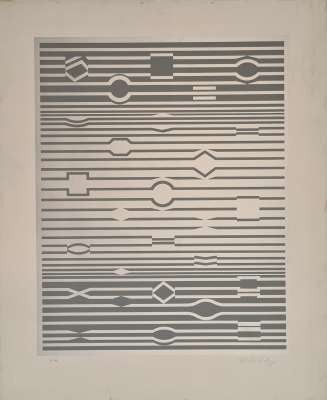
Victor Vasarely Mar-Kab
Victor Vasarely Mar-Kab
Couldn't load pickup availability
Mar-Kab
Silkscreen, 1973
Limited edition of 220
Publisher: Pierre Belfond (Paris)
Printer: Atelier Arcay (Paris)
Catalogue: Pedro Benavides 211
76.00 cm × 62.00 cm (sheet size)
60.00 cm × 48.00 cm (image size)
Signed by the artist in pencil
Artist Proof
Certificate of authenticity included
Condition: Good
Restoration marks on margin
Image area in very good condition
This work is currently held by our partner gallery in France. According to their standards, the condition is good, but please note that French and Japanese standards for evaluating the condition of vintage items may differ. Please consider purchasing only after acknowledging any signs of age-related wear (stains, discoloration, folds, wrinkles, tanning, etc.) typical of vintage items. We have not personally inspected the physical artwork. The work is currently stored in France, and delivery after ordering will take more than two weeks. Due to the nature of the artwork, returns after purchase are not accepted.
About the Work
《Mar-Kab》 is a representative silkscreen print from the 1970s, in which Victor Vasarely developed geometric abstraction and optical illusions through sophisticated compositions.
In this work, basic geometric forms emerge layer upon layer, floating above horizontally repeating lines. As forms gradually appear from the rhythm of ordered lines, a quiet vibration and spatial expansiveness are created on the canvas.
Particularly striking is the iridescent silvery glow that pervades the entire work. This delicate texture, which subtly changes its expression depending on the angle of the light, gives the work a unique depth and refined elegance.
This composition, which creates a three-dimensional illusion while remaining two-dimensional, symbolizes the "architecture of vision" that Vasarely pursued, leading the viewer to a different spatial perception with each viewing.
《Mar-Kab》 is a condensed masterpiece of Op Art, where mathematical order and poetic light effects are beautifully fused.
About the Title
This is a title that is somewhat difficult to interpret, but it is likely a neologism characteristic of Vasarely.
Dividing it:
Mar
→ Possible association with marbre (marble) or marine (sea)
Kab
→ Possible abbreviation for a geometric unit or structural code
Considering the work's particularly
silvery iridescent glow
it is possible that it was given as a code name indicating a material or mineral texture.
Vasarely often uses structural titles that do not explicitly state their meaning, so here, rather than forcing an interpretation,