ギャルリー亜出果
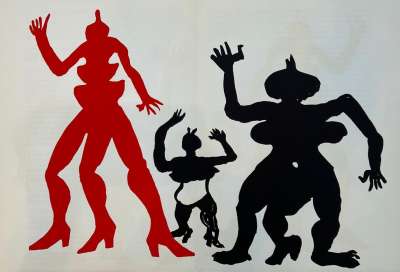
Alexander Calder, The Crazy Girls of Saché
Alexander Calder, The Crazy Girls of Saché
Couldn't load pickup availability
The Crazy Girls of Saché
Lithograph, 1975
Published by Maeght Editeur (Paris)
Printed by Imprimerie Arte (Paris)
38.00 cm × 56.50 cm (sheet size)
Unsigned
Accompanied by a Certificate of Authenticity
Condition: Excellent
Featured in the magazine "Derrière le Miroir" No. 212 (January 1975 issue)
This work is currently held by our partner gallery in France. While the condition is deemed good by French standards, please note that evaluation criteria for vintage items may differ between France and Japan. We kindly ask you to consider any signs of age (such as stains, discoloration, creases, wrinkles, or fading) typical of a vintage item before making a purchase. Please note that we have not personally inspected the physical item. The artwork is currently stored in France, and delivery may take over two weeks after your order. Due to the nature of the artwork, returns after purchase are not accepted.
Artwork Description
《The Crazy Girls of Saché》 is a captivating lithograph that symbolizes the free and poetic creative spirit of Alexander Calder's later years.
Saché, mentioned in the title, is a village located in the Loire region of France, where Calder established an important creative base from the 1960s onward. Works created during this period in his spacious studio strongly reflect the expansive freedom his art had achieved.
The light, three-legged forms depicted in the image seem to float through space as if dancing, conveying a sense of dynamism and humor to the viewer.
While seemingly composed of simple lines and colors, it is underpinned by Calder's unique and sophisticated sense of space.
Lines are not merely outlines but function as elements that move space and create rhythm.
This work brilliantly expresses a delicate dialogue of:
Balance and imbalance
Stillness and movement
Gravity and levitation
which is also evident in his representative mobile works.
As the word "Crazy" suggests, there is a playfulness hidden within order, and a free-spirited vitality.
It is not chaos, but a calculated lightness.
With extremely simple forms, Calder created a poetic world as if space itself had begun to dance.
This work is an excellent piece that vividly demonstrates the essence of Calder's art:
The poetics of movement
in a two-dimensional format.
Title Description