ギャルリー亜出果
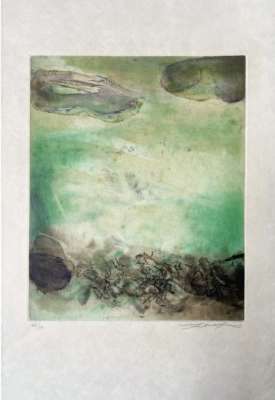
Zao Wou-Ki, Canto Pisan (plate 8)
Zao Wou-Ki, Canto Pisan (plate 8)
Couldn't load pickup availability
Etching/Aquatint, 1972
Limited edition of 50 (42/50)
Published by: Pierre Belfond (Paris)
Printer: Atelier Bellini (Paris)
Catalogue: Agerup 225
48.50 cm × 33.00 cm (sheet size)
31.70 cm × 25.70 cm (image size)
Signed in pencil
Certificate of authenticity included
Condition: Excellent
Included in "Canto Pisan"
Made with Japanese paper (Washi)
This work is currently held by our partner gallery in France. While the condition is described as "good" by French standards, please note that standards for assessing the condition of vintage items may differ between France and Japan. Please consider the purchase understanding that there may be signs of age (stains, discoloration, creases, wrinkles, fading, etc.) typical of a vintage item. We have not personally inspected the physical item. The work is currently stored in France, and delivery will take more than two weeks after your order. Due to the nature of the work, returns are not accepted after purchase.
Artwork Description
《Canto Pisan (plate 8)》 is one of a series of prints created by Zao Wou-Ki for the literary work "Canto Pisan" by the poet Ezra Pound.
This work showcases Zao Wou-Ki's unique poetic world, where literature and abstract painting deeply resonate with each other.
No specific scenes or figures are depicted on the canvas.
However, the expanse of translucent blue-green and the rhythm of delicately overlapping lines quietly evoke a space like light sinking deep beneath the water's surface, or fragments of distant memories.
Throughout his life, Zao Wou-Ki strived to express not "what is visible," but intangible elements such as:
Air
Time
Light
Presence
This spirit is strongly evident in this work.
The deep blue gradients evoke water and sky, yet they are never entirely confined to a landscape.
A very free abstract space is formed, which can be perceived as the sea, mist, cosmos, or even an internal spiritual realm, depending on the viewer's sensibility.
Furthermore, in this work, the soft texture unique to Japanese paper (washi) enriches the translucency and bleeding of colors.
The delicate gradations achieved through etching and aquatint create a quiet sense of breath, reminiscent of ink painting, where Western printmaking techniques and Eastern sensibility naturally merge.
In the 1970s, Zao Wou-Ki deepened his abstract expression in a more spiritual and poetic direction, and this work perfectly illustrates his mature worldview.
Although an illustration for a literary work, it is not merely a descriptive image, but rather a work that visualizes the lingering echoes and rhythm of the poetry itself.
Title Explanation
Canto Pisan
is derived from "The Pisan Cantos," a masterpiece by Ezra Pound.
"Canto" means "song" or "poem" in Italian,
and "Pisan" is an adjective related to Pisa, Italy.
Therefore,
Canto Pisan
means "The Pisan Cantos"
planche 8
"plate 8"
《Canto Pisan (The Pisan Cantos), plate 8》