ギャルリー亜出果
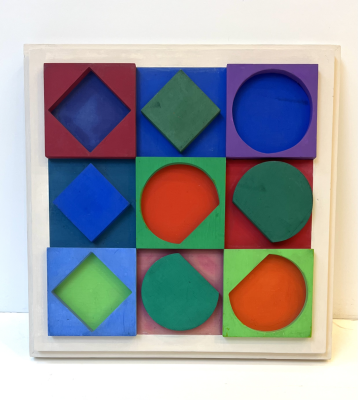
Victor Vasarely Beryl négatif Reversal of Beryl
Victor Vasarely Beryl négatif Reversal of Beryl
Couldn't load pickup availability
Relief 1967
Limited edition of 50 (47/50)
Published by: Denise René (Paris)
Catalog: [Benavides Vol. II 1893]
36.00 cm × 36.00 cm
Hand-signed by the artist in pencil
Accompanied by a Certificate of Authenticity
Title, notes, and signature on verso
Minor signs of age (restored and cleaned)
This piece is stored at our affiliated gallery in France. While the condition is considered good by French standards, please note that evaluation criteria for vintage items may differ between France and Japan. Please consider purchasing only if you are comfortable with signs of age and use typical of vintage items (such as stains, discoloration, creases, wrinkles, fading, etc.). Please note that we have not physically inspected the item. The artwork is currently stored in France, and delivery will take more than two weeks after your order. Due to the nature of the artwork, returns after purchase are not accepted.
Artwork Description
《Beryl négatif》 is an important relief work created by Victor Vasarely in 1967, showcasing his exploration of optical illusions and three-dimensional structures.
This work is one of a series of eleven square tableau reliefs published by the Denise René gallery in Paris, each having a "positive" and "negative" counterpart.
With precisely arranged geometric basic forms, vibrant colors, and a three-dimensional relief structure, the surface generates a strong sense of depth and spatial vibration. The intricate interplay of flat and three-dimensional, protrusion and depression, light and shadow, provides the viewer with a constantly changing visual experience.
As indicated by the title "négatif," this work explores spatial relationships by inverting the usual structure, creating a unique tension as convex and concave, foreground and background, are reversed.
The materiality inherent in a wooden relief and its vivid colors powerfully embody Vasarely's formative philosophy, which can be described as "the architecture of vision."
This is an extremely important work, demonstrating how Op Art transcended two-dimensional expression and expanded into actual three-dimensional space.