
ギャルリー亜出果
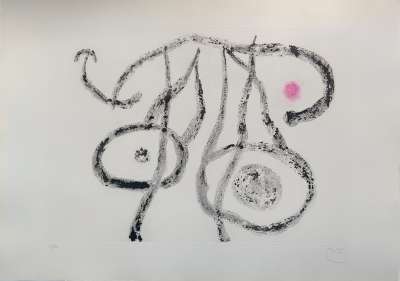
Joan Miro [Water Carrier I] 1962 Image size 75x105cm Original aquatint
Joan Miro [Water Carrier I] 1962 Image size 75x105cm Original aquatint
Couldn't load pickup availability
Limited to 75 copies, signed by the artist.
This work is kept in a partner gallery in France. Although the condition is considered good by local (French) standards, the standards for evaluating the condition of aged items may differ between France and Japan. Please consider purchasing only if you understand that the item may show signs of age (stains, discoloration, creases, wrinkles, fading, etc.) as a vintage item. Please note that we have not personally inspected the actual item. **More detailed photos of the condition are available, so please inquire before purchasing.** The work is currently stored in France, and it will take at least 2 weeks for delivery after your order. Due to the nature of the work, returns after purchase are not accepted.
A representative painter of the École de Paris from Barcelona. While participating in the Surrealist movement in Paris, he was heavily influenced by Surrealism, but instead of using elongated lines, he created his own unique object forms, forming Miró's unique abstract world of joyful music. He expanded his activities to include paintings, prints, ceramics, sculptures, and outdoor mural sculptures, achieving success worldwide.
1893 Born in the transverse of Spain as the son of a jewel and watchmaker.
1907 Entered La Llotja Art School in Barcelona.
1912 Entered Francisco Galí Art School.
1915 Began painting unique portraits and landscapes while being influenced by the Fauves in France.
1918 Held a solo exhibition at Sala Dalmau.
1919 Traveled to Paris and interacted with Picasso. Enjoyed barbecue and Paris for the next 20 years.
1920 Participated in the Dadaist movement.
1923 Began drawing symbolic paintings, moving away from realism.
1924 Participated in the Surrealist movement with André Breton and others.
1926 Responsible for set design for the Russian Ballet's Romeo and Juliet.
1930 Solo exhibitions in Paris, Brussels, and New York. Created his first lithographs.
1931 Exhibition of objects and sculptures at a Paris gallery.
1933 Produced his first etching.
1936 Exiled to France.
1940 Created the representative "Constellations" series, establishing Miró's unique geometric expression.
Moved to Majorca, Spain.
1941 Museum of Modern Art in New York held a retrospective.
1946 Exhibited alongside Dalí, Picasso, and Gris at the "Four Spaniards" exhibition in Boston.
1947 First visit to New York, created a large mural.
Around this time, he became a globally renowned and acclaimed painter, with retrospectives and exhibitions held worldwide, and museums globally vying to acquire his works.
1949 Retrospective at Kunsthalle Bern.
1950 Solo exhibition of objects and prints at Galerie Maeght in Paris.
1951 Solo exhibitions in New York and Houston.
1953 Solo exhibitions at Galerie Maeght in Paris and Matisse Gallery in New York.
1954 Retrospective at Kaiser Wilhelm Museum in Germany.
1960 Created ceramic mural at Harvard University.
1962 Major retrospective at the Musée National d'Art Moderne in Paris.
1966 Visited Japan for major retrospectives in Tokyo and Kyoto.
1967 Miró mural installed at the Solomon R. Guggenheim Museum in New York.
1973 An exhibition of sculptures and ceramics is held at the Maeght Foundation in Saint-Paul-de-Vence. The Museum of Modern Art in New York holds the "Miro Collection at the Museum of Modern Art" exhibition.
1975 The Joan Miró Foundation - Center for the Study of Contemporary Art, designed by Josep Lluís Sert, opens in Montjuïc Park, Barcelona.
1979 Retrospective exhibition of paintings, sculptures, drawings, and watercolors held at the Maeght Foundation.
1983 The Miró Foundation in Barcelona holds the "Joan Miró: Anys20" exhibition featuring paintings from the 1920s. Continues at his home in Palma de Mallorca.
The Joan Miró Museum in Barcelona houses over 10,000 works, and works from museums around the world, such as the Centre Pompidou in Paris and the Metropolitan Museum of Art in New York, are also housed there.
Work explanation
It is drawn with thick, soft, continuous black lines. The black lines include white and gray of different gradations, giving a hazy impression. This expression of different gradations is unique to the aquatint technique. Only these multiple lines depict the human body and the water buckets in front and behind. Circles of mixed black, gray, and white are drawn in the water buckets, suggesting that there is water in the tanks. The water, moved by the movement of the water carrier, shakes and irregularly reflects the surrounding colors. The shaking of the water is expressed by the change in gradation from black to white.
