
ギャルリー亜出果
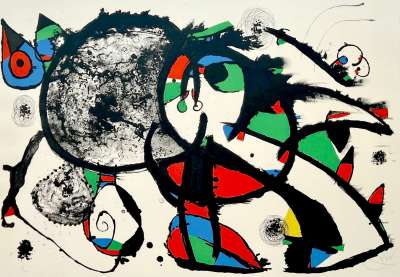
Joan Miro [Tribute to Andre Masson] 1977 Image size 63x90cm Original lithograph
Joan Miro [Tribute to Andre Masson] 1977 Image size 63x90cm Original lithograph
Couldn't load pickup availability
Limited to 100 copies, signed by the artist.
This piece is one of a kind, stored at our partner gallery in France. According to local (French) standards, the condition is good, but standards for evaluating the condition of aged items may differ between France and Japan. Please consider purchasing only after acknowledging the signs of age from vintage use (stains, discoloration, folds, wrinkles, tanning, etc.). Please note that we have not inspected the actual item. **More detailed condition photos are available upon request, so please inquire before purchasing.** The artwork is currently stored in France, and it will take more than 2 weeks for delivery after your order. Due to the nature of the artwork, returns after purchase are not accepted.
A representative painter of the École de Paris from Barcelona. While participating in the Surrealist movement in Paris, he was heavily influenced by Surrealism, but instead of its elongated continuous lines, he created his own unique object forms, establishing Miró's unique abstract world of joyful music. He expanded his activities to include paintings, prints, ceramics, sculptures, and outdoor mural sculptures, achieving global success.
1893: Born in Spain, the son of a gem and watch craftsman.
1907: Enrolled in La Llotja School of Art in Barcelona.
1912: Enrolled in Francesc Galí Art School.
1915: Began painting unique portraits and landscapes while influenced by French Fauvism.
1918: Held a solo exhibition at Dalmau Gallery.
1919: Traveled to Paris and interacted with Picasso. Enjoyed barbecues and Paris for the next 20 years.
1920: Participated in the Dada movement.
1923: Began painting symbolic pictures, moving away from realism.
1924: Participated in the Surrealist movement with André Breton and others.
1926: Designed the stage for the Russian Ballet's Romeo and Juliet.
1930: Solo exhibitions in Paris, Brussels, and New York. Produced his first lithographs.
1931: Exhibited object sculptures at a Paris gallery.
1933: Repeated his first etchings.
1936: Exiled to France.
1940: Created his representative "Constellations" series, establishing his unique pictorial expression.
Moved to Mallorca, Spain.
1941: The Museum of Modern Art in New York held a retrospective.
1946: Exhibited alongside Dali, Picasso, and Gris at the "Four Spaniards" exhibition in Boston.
1947: Visited New York for the first time and created large murals.
Around this time, he became a globally renowned artist, and his reputation and critical acclaim grew. Retrospectives and exhibitions were held, and museums worldwide competed to acquire his works.
1949: Retrospective at Bern Kunsthalle.
1950: Solo exhibition of objects and prints at Galerie Maeght in Paris.
1951: Solo exhibitions in New York and Houston.
1953: Solo exhibitions at Galerie Maeght in Paris and Matisse Gallery in New York.
1954: Retrospective at Kaiser Wilhelm Museum in Germany.
1960: Created ceramic murals for Harvard University.
1962: Major retrospective at the National Museum of Modern Art in Paris.
1966: Visited Japan for major retrospectives in Tokyo and Kyoto.
1967: Miró mural installed at the Solomon R. Guggenheim Museum in New York.
1973: Solo exhibition of sculptures and ceramics at the Maeght Foundation in Saint-Paul-de-Vence. "Miró Collection at The Museum of Modern Art" exhibition held at The Museum of Modern Art in New York.
1975: Fundació Joan Miró - Centre for the Study of Contemporary Art, designed by Josep Lluís Sert, opened in Montjuïc Park, Barcelona.
1979: Retrospective of paintings, sculptures, drawings, and watercolors at the Maeght Foundation.
1983: "Joan Miró: Anys 20" exhibition of paintings from the 1920s held at the Miró Foundation in Barcelona. Continued at his home in Palma de Mallorca.
The Fundació Joan Miró in Barcelona houses over 10,000 works, and his works are also held in museums worldwide, including the Centre Pompidou in Paris and the Metropolitan Museum of Art in New York.
Work Explanation
This lithograph is a work Miró created for his friendship with Masson. When Miró moved to the Montparnasse district in 1921, he and Masson, both neighbors and devoted to Surrealism, also conducted unconscious experiments of Surrealism with Georges Bataille and others. The spontaneity of movement seen in Masson's work can be felt in the bold, smudged lines and the trembling chaos within the circles. By crossing and overlapping lines, a sense of three-dimensionality not found in other Miró works is created.
![Joan Miro [Tribute to Andre Masson] 1977 Image size 63x90cm Original lithograph](http://adekat-gallery.com/cdn/shop/files/miro-34co.jpg?v=1736139495&width=1445)