ギャルリー亜出果
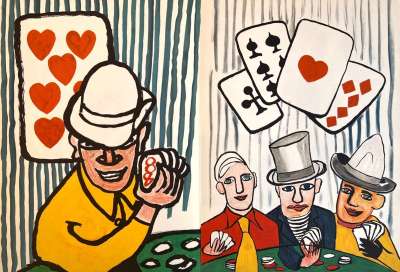
Alexander Calder: Joueurs de cartes I et Joueur de cartes II (Card Players)
Alexander Calder: Joueurs de cartes I et Joueur de cartes II (Card Players)
Couldn't load pickup availability
Lithograph, 1975
Publisher: Maeght Editeur (Paris)
Printer: Imprimerie Arte (Paris)
38.00 cm × 56.50 cm (sheet size)
Unsigned
Certificate of authenticity included
Condition: Excellent
Featured in the magazine "Derrière le Miroir"
This artwork is held by our partner gallery in France. While its condition is described as good by French standards, please note that evaluation criteria for vintage items may differ between France and Japan. We ask that you consider purchasing this piece with an understanding that it may have age-related signs of use (stains, discoloration, creases, wrinkles, foxing, etc.) typical of a vintage item. We have not personally inspected the physical item. The artwork is currently stored in France, and delivery after your order will take at least two weeks. Due to the nature of the artwork, returns after purchase cannot be accepted.
Artwork Description
In "Joueurs de cartes I et Joueur de cartes II," Alexander Calder reinterprets the classical theme of "card playing," which has appeared repeatedly throughout art history, with his unique sense of lighthearted form.
Card playing has been a traditional theme depicted by many painters since the 17th century.
Elements such as quiet psychological battles, negotiation, and the subtleties of human relationships have often been emphasized.
However, Calder deliberately deconstructs this weighty tradition with a light touch.
His figures are freed from detailed depiction and psychological explanation, expressed simply, almost symbolically, through free lines and vibrant colors.
What is present is not winning or losing, or tension,
but rather,
movement
rhythm
the energy of play
itself.
For Calder, what was important was not to reproduce the scene, but to capture the dynamism of life within it through lines.
Just as he moved space in his sculptures, in this lithograph, lines move lightly across the canvas, guiding the viewer's gaze naturally.
Within the seemingly improvisational composition breathes Calder's unique and exquisite sense of balance.
This work sublimates an everyday motif into poetic abstraction, vividly demonstrating the joy of play and form.